
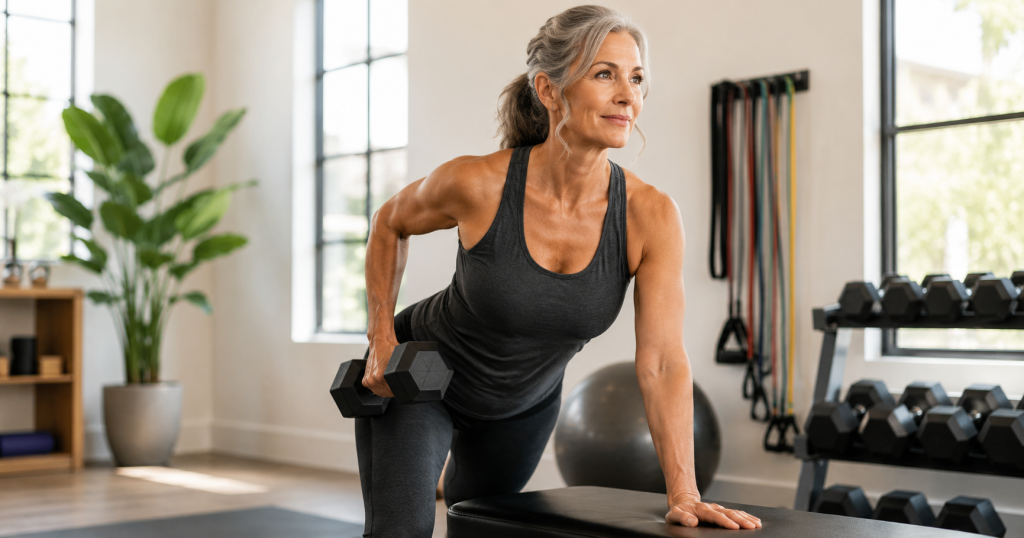
A widely shared study suggests that regular strength training may be associated with a biological age nearly eight years younger. That sounds impressive… but what does it really mean?
The research did not prove that lifting weights reverses aging. It found that adults who reported doing more strength training tended to have longer telomeres, a marker associated with cellular aging. For women over 45, the more important message may be less sensational but far more practical: resistance training can help preserve muscle, support bone health, improve strength and body composition, and make everyday life easier as you move through perimenopause, menopause, and beyond.
Can Strength Training Make Your Body 8 Years Younger?
Imagine being told that a few weekly strength-training sessions could make your body nearly eight years younger. It is the kind of headline that immediately gets attention, especially when so many women are trying to protect their health, energy, mobility, and independence as they move through perimenopause and menopause.
The claim comes from a study involving almost 5,000 American adults. Researchers found that people who reported doing more strength training tended to have longer telomeres, which are protective structures at the ends of chromosomes. Because telomeres generally become shorter as cells divide and age, they are sometimes used as one indicator of biological aging.
The researchers calculated that 90 minutes of strength training per week was associated with telomere lengths corresponding to approximately 3.9 fewer years of biological aging. When that mathematical relationship was extended to 180 minutes per week, the difference was equivalent to approximately 7.8 years.
That is where the “eight years younger” headline comes from. But before you rush out to buy the heaviest dumbbells you can find, there are a few important details to understand.
The Quick Answer…
Can strength training literally make your entire body eight years younger?
Not exactly, but don’t get discouraged yet. The study found an association between self-reported strength training and longer telomeres. It did not prove that lifting weights caused the participants to become biologically younger, reverse aging, or live eight years longer.
However, strength training is still one of the most valuable forms of exercise women can add after age 45. Research supports its ability to improve muscular strength, preserve or increase lean mass, support physical function, improve body composition, and contribute to healthier bones… and this is where the good news are. In other words, the headline may oversimplify the science, but the underlying message is worth your attention.
So, What Did the Study Actually Find?
The study, published in the journal Biology in 2024, included 4,814 adults between the ages of 20 and 69. The participants came from the National Health and Nutrition Examination Survey, commonly known as NHANES.
Researchers measured the length of telomeres in blood cells and compared those measurements with the amount of strength training participants reported performing each week. After accounting statistically for factors including age, sex, race, income, body mass index, smoking history, and physical activity outside of strength training, the researchers found a positive association between time spent strength training and telomere length.
For every additional 10 minutes of reported weekly strength training, telomeres were an average of approximately 6.7 base pairs longer after the full statistical adjustment. The study also calculated that:
- Ninety minutes of strength training per week was associated with telomeres approximately 60 base pairs longer.
- In this study population, each additional year of chronological age was associated with telomeres approximately 15.5 base pairs shorter.
- Dividing those numbers produced the estimate of 3.9 fewer years of biological aging for 90 minutes of weekly training.
- Doubling the training time to 180 minutes produced the widely reported estimate of 7.8 fewer years.
Those results are interesting, but they should not be interpreted as a guaranteed anti-aging formula.
What Are Telomeres?
Telomeres are repeating sections of DNA located at the ends of chromosomes. You can think of them somewhat like the protective tips on shoelaces: they help prevent chromosome ends from becoming damaged, frayed, or tangled.
Each time many types of cells divide, their telomeres become slightly shorter. Eventually, they may become too short for the cell to continue dividing normally. For this reason, shorter telomeres have been studied as one marker of cellular aging.
However, telomere length is not a complete measurement of your health. A person’s biological aging is influenced by many systems and factors, including:
- Cardiovascular health
- Blood sugar regulation
- Muscle mass and strength
- Bone health
- Brain function
- Immune function
- Sleep
- Nutrition
- Smoking
- Stress
- Genetics
- Environmental exposures
Telomeres provide one piece of a very large puzzle. They do not tell us exactly how strong, fit, mobile, cognitively healthy, or disease-free a person is. That is why it would be misleading to say that a woman who begins strength training will literally transform every part of her 58-year-old body into that of a 50-year-old.
Why the “Eight Years Younger” Claim Needs Context
The study gives us a useful reason to continue researching strength training and cellular aging, but it has several important limitations.
It was an observational study
Researchers observed an association between strength training and telomere length. They did not randomly assign one group to strength train for years and another group to remain inactive. That means the study cannot establish cause and effect.
People who strength train regularly may differ from non-lifters in other ways. They may eat differently, sleep better, have better access to healthcare, manage stress more effectively, or practice other health-supportive habits that are difficult to measure completely.
Exercise was self-reported
Participants reported how much strength training they performed. Self-reported information is not always completely accurate. Some people may overestimate how long or how intensely they exercise. Others may forget short workouts or underestimate their activity. The researchers also did not provide every participant with the same supervised strength-training program.
The study measured telomeres at one point in time
This was not a long-term intervention showing that a specific lifting program lengthened telomeres over several years. The researchers compared participants’ reported exercise habits with telomere measurements collected during the survey. Therefore, we cannot say with certainty that strength training caused the telomeres to become longer.
The eight-year figure was a mathematical interpretation
The study directly reported a relationship between weekly strength-training minutes and telomere length. Researchers then compared the telomere difference with the average shortening associated with chronological age in that sample.
The 7.8-year estimate came from extending the statistical relationship to 180 minutes of weekly training. It was not the result of giving participants a medical test that declared their entire bodies eight years younger. This does not make the study meaningless. It simply means the results should be described accurately.
Why Strength Training Matters So Much After 45
You do not need an anti-aging headline to justify picking up a pair of dumbbells. The more immediate, well-established benefits of resistance training are especially relevant during perimenopause and menopause.
1. It Helps Protect Muscle Mass and Strength
Muscle is not only about appearance. You rely on it every time you stand up from a chair, carry groceries, climb stairs, lift a suitcase, get down on the floor, or catch yourself when you lose your balance.
Muscle mass and strength tend to decline with age. Midlife may also bring changes in activity, sleep, protein intake, body composition, and hormones that make muscle preservation more challenging. Research in women between approximately 40 and 60 has found that resistance training can improve muscle strength and help counter age- and menopause-related changes in muscle mass and body composition.
A 2024 study also found that 12 weeks of progressive whole-body resistance exercise increased muscle thickness, strength, grip strength, and physical performance in postmenopausal women. You do not have to become a bodybuilder. The goal is to maintain enough muscle to remain active, capable, and independent.
2. It Supports Bone Health
Bone is living tissue that responds to the demands placed on it. Resistance exercises create muscular forces that pull on bone. When training is appropriately designed and progressively challenging, this stimulus can help support bone strength.
This becomes increasingly important after menopause because declining estrogen is associated with accelerated bone loss in many women. Women with osteopenia or osteoporosis may need an individualized program, but avoiding all resistance is not usually the answer.
Systematic reviews have found that exercise can improve or help preserve bone mineral density in postmenopausal women, although results vary according to exercise type, intensity, duration, and the bone site being measured.
The well-known LIFTMOR trial found that a supervised high-intensity resistance and impact program improved measures of bone strength and physical function in postmenopausal women with low bone mass. That does not mean every woman with osteoporosis should begin heavy lifting on her own. It shows that properly supervised resistance exercise may be both feasible and beneficial for appropriately screened women.
3. It Can Improve Body Composition
The number on the scale does not tell you how much of your weight is muscle, fat, bone, or water.
During midlife, a woman can remain at approximately the same body weight while gradually losing muscle and gaining fat. This can affect strength, metabolism, insulin sensitivity, and how clothing fits. Resistance training provides a direct stimulus for preserving or building lean tissue. Reviews involving postmenopausal women have found that exercise —and resistance training in particular— can improve body composition, muscular strength, and physical function.
Resistance training may also help reduce body fat and metabolic risk, particularly when paired with appropriate nutrition and aerobic activity. It will not selectively burn fat from your stomach, and it cannot override an eating pattern that consistently provides more energy than your body uses. Its value during weight loss is that it helps protect the muscle you do not want to lose.
4. It Makes Everyday Tasks Easier
One of the most useful ways to measure fitness is to ask:
What does your body allow you to do comfortably?
- Can you carry your luggage?
- Can you lift a heavy bag into your car?
- Can you get up from the floor without struggling?
- Can you climb stairs without feeling unstable?
- Can you keep doing the hobbies and activities you enjoy?
Strength training improves your ability to produce force. Over time, ordinary tasks may require a smaller percentage of your available strength, making them feel easier. Physical activity that combines aerobic, strengthening, and balance exercises also supports mobility and may reduce fall risk as women grow older.
5. It Supports Long-Term Independence
Healthy aging is not simply about adding years to life. It is also about preserving the ability to make choices, care for yourself, travel, work, socialize, and participate in daily life. The National Institute on Aging identifies strength training as an important part of healthy aging because it supports muscle strength, mobility, physical function, and the ability to continue performing everyday activities. That may be a more meaningful definition of “younger” than any laboratory estimate.
How Much Strength Training Do Women Need?
The Physical Activity Guidelines for Americans recommend that adults perform muscle-strengthening activities involving all major muscle groups on at least two days per week.
They also recommend 150 to 300 minutes of moderate-intensity aerobic activity, 75 to 150 minutes of vigorous aerobic activity, or an equivalent combination each week. Strength training and aerobic exercise provide overlapping but distinct benefits, which is why both are recommended.
The telomere study found an association at 90 minutes of weekly strength training, but 90 minutes is not a magic minimum, and 180 minutes is not required to benefit. The most recent American College of Sports Medicine resistance-training guidance emphasizes that the greatest step for most people is moving from no resistance training to consistent resistance training. Training all major muscle groups at least twice weekly matters more than following an unnecessarily complicated program.
A practical starting point might be:
- Two full-body sessions per week
- Approximately 20 to 30 minutes per session
- One or two sets of each exercise
- A level of resistance that feels challenging while allowing controlled form
- At least one recovery day before training the same muscles again
As your strength and confidence improve, you can gradually add weight, repetitions, sets, exercises, or a third weekly session.
What Counts as Strength Training?
Strength training does not have to involve a crowded gym or a barbell loaded with heavy plates.
Your muscles respond whenever they must work against resistance. Examples include:
- Dumbbells
- Resistance bands
- Weight machines
- Kettlebells
- Cable machines
- Bodyweight exercises
- Weighted household objects
- Some Pilates exercises
- Certain yoga positions
- Carrying weighted objects
- Calisthenics
Updated ACSM guidance notes that bodyweight exercises, elastic bands, free weights, machines, and home-based routines can all produce meaningful improvements. Complicated equipment and advanced training techniques are optional for the average healthy adult. The resistance needs to be challenging enough to encourage adaptation, but that challenge can come from many different tools.
A Simple Beginner Strength Routine
This example is intended for generally healthy women who have been cleared for exercise. Modify the movements according to your fitness level, joint health, balance, and medical history.
Begin with five to ten minutes of easy movement, such as walking, marching in place, shoulder circles, and gentle practice repetitions. Then perform the following exercises.
1. Chair Squat or Sit-to-Stand
Sit toward the front of a sturdy chair with your feet planted. Stand up using your legs, then lower yourself with control.
This movement strengthens the thighs, hips, and glutes while practicing an essential daily activity.
2. Wall or Counter Push-Up
Place your hands on a wall or stable countertop. Bend your elbows as you bring your chest toward the surface, then press away.
This works the chest, shoulders, arms, and core without requiring a floor push-up.
3. Resistance-Band or Dumbbell Row
Pull the resistance toward your body while keeping your shoulders down and your spine steady.
Rows strengthen the upper back and arms and help balance the pressing movements we perform during daily life.
4. Hip Hinge
With your knees slightly bent, push your hips backward while keeping your spine long. Return to standing by pressing through your feet and tightening your glutes.
Once you understand the movement, you may hold dumbbells or another weight.
5. Step-Up or Supported Reverse Lunge
Step onto a low, stable platform or step one foot backward into a shallow lunge while holding a sturdy support.
This works the hips and legs while also challenging balance.
6. Overhead Press or Incline Press
Press light dumbbells upward if your shoulders tolerate the movement comfortably. A trainer or physical therapist can provide an alternative if overhead movement causes pain.
7. Carry
Hold a dumbbell, kettlebell, or safely secured household weight and walk with controlled posture.
Carries train grip strength, core stability, posture, and the ability to transport everyday items.
Start with approximately 8 to 12 controlled repetitions of each movement, or 20 to 30 seconds for a timed exercise. Rest as needed.
The final repetitions should require effort, but you should still be able to maintain proper form. Current ACSM guidance indicates that routinely training to complete muscular failure is not necessary for most healthy adults to make progress.
How to Progress Without Overdoing It
Your body needs a reason to adapt. If you perform the same easy workout indefinitely, your progress may eventually slow.
However, progression should be gradual. You might progress by:
- Adding one or two repetitions
- Using a slightly heavier dumbbell
- Choosing a stronger resistance band
- Adding a second or third set
- Increasing the range of motion
- Performing the exercise with less external support
- Slowing the lowering phase
- Advancing to a more challenging version
Change one variable at a time. Muscle fatigue is expected. Sharp pain, chest pressure, dizziness, unusual breathlessness, or pain that worsens as you continue are reasons to stop and seek appropriate medical guidance.
Do You Have to Lift Heavy Weights?
Heavy is relative. A weight that is light for one person may be very challenging for someone else. You do not need to compare your dumbbells with anyone else’s.
The 2026 ACSM position stand concluded that many resistance-training approaches can improve muscle function. Heavier loads are generally more effective when the specific goal is maximizing strength, while greater weekly volume can support muscle growth. However, bodyweight movements, bands, machines, free weights, and home programs can all work.
Beginners should first learn controlled movement and develop consistency. As technique improves, gradually using more resistance can provide an additional stimulus. Women with osteoporosis, significant joint disease, recent surgery, uncontrolled cardiovascular conditions, balance problems, or persistent pain should seek individualized guidance before beginning heavy or high-impact exercise.
Strength Training Does Not Replace Walking or Cardio
Walking is excellent exercise. It supports cardiovascular health, mood, mobility, blood sugar management, and general activity. But walking and strength training do different jobs.
Walking does not usually provide enough resistance to challenge all the major muscles through a meaningful range of motion. Strength training does not provide all the cardiovascular benefits of sustained aerobic activity. For most women, the ideal program includes:
- Strength training
- Aerobic movement
- Balance work
- Mobility or flexibility
- Everyday physical activity
You do not have to fit everything into one workout. A woman might strength train on Monday and Thursday, walk on several other days, and include a few minutes of balance or mobility work throughout the week.
Support Your Training With Adequate Nutrition
Exercise provides the stimulus for adaptation. Nutrition supplies the materials and energy your body needs to respond. Women who strength train should pay particular attention to:
- Eating adequate protein
- Distributing protein across meals
- Consuming enough total energy
- Including calcium-rich foods
- Obtaining adequate vitamin D
- Eating fruits, vegetables, whole grains, and healthy fats
- Staying hydrated
Severe calorie restriction paired with intense exercise can make it more difficult to recover, maintain muscle, and sustain energy. Protein becomes particularly important when a woman is losing weight because the goal should be to lose excess body fat while preserving as much lean tissue as possible.
When Should You Speak With a Professional?
Most women can begin with light or moderate resistance and gradual progression. However, professional guidance is especially valuable when you have:
- Osteoporosis or a history of fracture
- Significant back, hip, knee, or shoulder pain
- Recent surgery
- Pelvic floor symptoms
- Balance difficulties
- Neurological conditions
- Cardiovascular disease
- Uncontrolled high blood pressure
- Diabetes complications
- A long period of inactivity
- Uncertainty about exercise technique
A qualified physical therapist, clinical exercise professional, or certified trainer experienced in working with women in midlife can help you choose safe movements and appropriate starting resistance.
The Bottom Line
Strength training cannot stop the clock, and one observational study does not prove that lifting weights will literally make your entire body eight years younger.
The study found that adults who reported doing more resistance training tended to have longer telomeres, a marker associated with cellular aging. Ninety minutes per week was associated with an estimated 3.9 fewer years of biological aging, and the widely publicized eight-year figure came from mathematically extending that relationship to 180 minutes per week. That is intriguing, but it is not a guarantee.
The better reason to begin strength training is what it can help you protect today: your muscle, bones, balance, mobility, metabolic health, physical confidence, and ability to live independently.
You do not need an extreme program. You do not need to spend hours in the gym. You do not even need traditional weights to begin. Start with two manageable full-body sessions each week. Learn the movements, allow time for recovery, and increase the challenge gradually.
The most effective strength program is not the most complicated one. It is the one you can perform safely, consistently, and progressively for years to come.
Reviewed by Coach Tammy
Coach Tammy Bar is a Certified Life Coach, Health Coach, Type 2 Diabetes Educator, and Humanistic Psychology Counselor with over 25 years of experience in health promotion through education.
She coaches women to improve their energy, metabolic health, and sustain healthy lifestyle habits. She helps women navigate midlife transitions, including blood sugar balance, hormone health, weight management, and lifestyle strategies that promote long-term vitality. Her approach combines science-based nutrition, behavioral psychology, and practical daily routines designed for real life.
Through TBHealthy, Coach Tammy educates women simplify health decisions and build habits that support energy, clarity, and resilience during hormonal changes such as perimenopause and menopause.
Medical Disclaimer: This article is for educational purposes only and does not replace personalized medical advice. Always consult your healthcare provider regarding medical conditions or treatment decisions.
Frequently Asked Questions
1. Is it too late to start strength training after 50?
No. Women can improve muscular strength, physical performance, and muscle mass after 50 and well beyond. Research involving postmenopausal women has documented meaningful improvements after progressive resistance-training programs, including programs lasting approximately 12 weeks. Begin at a level appropriate for your current health and fitness rather than trying to match someone who has trained for years.
2. How many days a week should a woman over 45 lift weights?
Two nonconsecutive full-body sessions per week are an effective starting point and meet current muscle-strengthening recommendations. Some women eventually prefer three or four sessions, particularly when dividing the body into different training days. More sessions are not automatically better if the program interferes with recovery or becomes difficult to maintain.
3. Is 20 minutes of strength training enough?
Twenty minutes can be enough for a useful full-body workout, particularly for a beginner who chooses a small number of effective exercises and limits unnecessary rest. You do not need to reach 90 or 180 weekly minutes before receiving benefits. Consistency and progressive challenge matter more than reaching the number reported in one telomere study.
4. Does strength training help with menopause belly fat?
Strength training cannot target fat loss specifically from the abdomen. It can help preserve or increase lean mass, improve body composition, and support metabolic health. When combined with appropriate nutrition, aerobic activity, sleep, and an overall energy deficit when weight loss is needed, it can be a valuable part of a body-composition plan.
5. Is walking enough exercise during menopause?
Walking is highly beneficial, but it does not fully replace resistance training. Women should ideally combine aerobic activity such as walking with muscle-strengthening exercises at least twice weekly. Balance and mobility exercises become increasingly valuable with age as well.
6. Are resistance bands as effective as weights?
Resistance bands can effectively strengthen muscles, especially when the band creates enough challenge throughout the movement. Free weights, bands, bodyweight movements, and machines can all produce results. The best equipment is the type you can use safely, progressively, and consistently.
7. Should women lift lighter weights for more repetitions?
Women do not need a special “toning” program built entirely around very light weights. Different combinations of weight and repetitions can improve fitness. Heavier resistance generally provides a stronger stimulus for maximum strength, while moderate or lighter resistance can also build muscle when the exercise becomes sufficiently challenging. Your goal, experience, joint health, and technique should determine the appropriate resistance.
8. How long does it take to notice results?
Some women notice that exercises and daily tasks feel easier within several weeks. Visible muscle or body-composition changes usually take longer and depend on the training program, nutrition, sleep, genetics, and starting point. Studies in postmenopausal women have measured improvements in muscle size, strength, and physical performance after approximately 12 weeks of progressive training.
9. Do I need a gym?
No. You can begin at home with a chair, resistance band, bodyweight exercises, and a few dumbbells. A gym provides more equipment and easier ways to increase resistance, but it is not required. Updated ACSM guidance recognizes home-based, bodyweight, and elastic-band programs as effective options.
10. Can strength training make osteoporosis worse?
An appropriately designed program may help support bone health. However, certain exercises, loads, and spinal movements may not be suitable for every woman with osteoporosis or a history of vertebral fracture. Women with low bone density should ask their healthcare provider or a qualified physical therapist for individualized exercise guidance before beginning heavy lifting or impact training.