
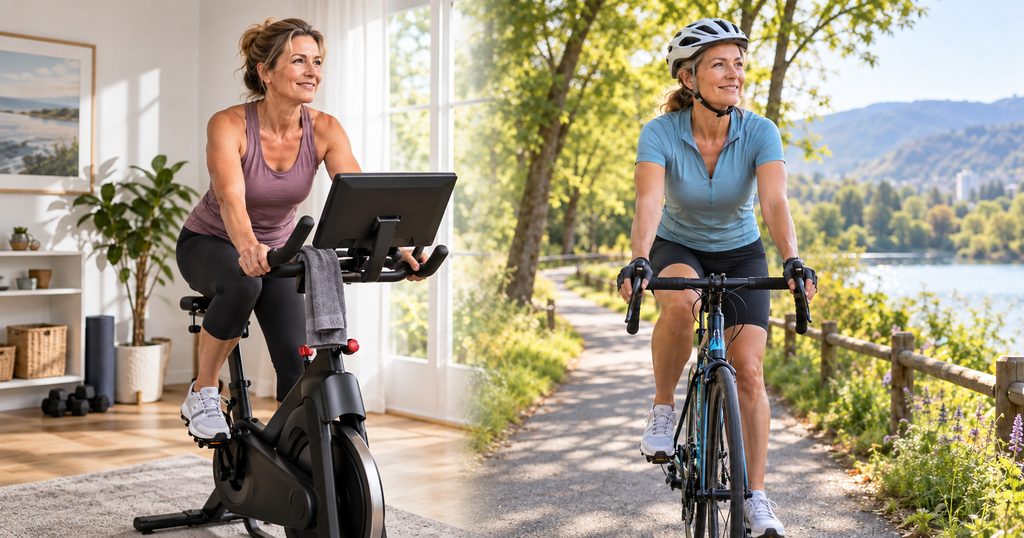
Cycling is a joint-friendly cardiovascular workout that can improve endurance, strengthen the lower body, and make regular exercise more enjoyable. For women over 40, it can be especially appealing because the intensity is easy to adjust according to energy level, experience, and physical ability.
But is riding outdoors better than taking an indoor cycling class or using a stationary bike at home? Both offer meaningful health benefits, although they challenge the body and mind differently. Understanding those differences can help you choose the option that fits your goals, schedule, and lifestyle.
Indoor vs. Outdoor Cycling for Women Over 40
Cycling can be one of the most practical ways to bring more movement into your life after 40. It is adaptable, relatively gentle on the joints, and appropriate for a wide range of fitness levels. You can ride at a relaxed pace, add hills or resistance for a more demanding workout, or alternate between easier and harder intervals.
The Centers for Disease Control and Prevention recommends that adults accumulate at least 150 minutes of moderate-intensity aerobic activity or 75 minutes of vigorous activity each week, along with muscle-strengthening exercise on at least two days. Indoor and outdoor cycling can both contribute to the aerobic portion of that goal.
The question is not whether cycling is worthwhile. It is which type of cycling is more likely to keep you active, comfortable, and consistent.
Why Cycling Can Be a Smart Choice After 40
As women move through their 40s and beyond, maintaining cardiovascular fitness, muscle strength, mobility, and metabolic health becomes increasingly important. Hormonal changes associated with perimenopause and menopause may also affect body composition, sleep, energy, and recovery.
Cycling works the heart and lungs while recruiting major muscles in the legs, including the quadriceps, hamstrings, calves, and glutes. Increasing the resistance or riding uphill makes these muscles work harder. Cycling can therefore support muscular endurance and some strength development, particularly in beginners, but it should not replace a complete resistance-training program.
Another advantage is that cycling is low impact. Your body is supported by the bicycle seat, so your hips, knees, and ankles do not absorb the repeated landing forces associated with running and jumping. This may make cycling more comfortable for women who experience joint sensitivity or who are returning to exercise after a period of inactivity.
Low impact, however, does not automatically mean appropriate for every injury or health condition. A poorly fitted bicycle, excessive resistance, or a rapid increase in training can still cause knee, hip, back, or neck discomfort.
The Benefits of Indoor Cycling
Indoor cycling includes stationary bikes at home, traditional exercise bikes at a gym, instructor-led spin classes, and interactive cycling programs.
It Offers a Controlled Environment
One of the greatest advantages of indoor cycling is predictability. You do not have to think about traffic, road conditions, darkness, heat, rain, or uneven terrain. This control can make it easier to exercise consistently throughout the year.
Indoor cycling may also feel more approachable for beginners who are not comfortable balancing a bicycle, riding near cars, or navigating unfamiliar routes.
You Can Control the Intensity Precisely
A stationary bike allows you to adjust the resistance, speed, and duration without worrying about stop signs, intersections, or unexpected hills. This makes it convenient for steady cardiovascular workouts and structured interval sessions.
You can also slow down immediately if you feel tired, overheated, lightheaded, or uncomfortable. This can be reassuring for women who are rebuilding their stamina or learning how their body responds to exercise.
It Is Convenient and Time-Efficient
With a stationary bike at home, you can exercise without traveling to a gym or planning a route. Even a brief session can add meaningful movement to a busy day.
Women balancing work, family obligations, caregiving, or unpredictable schedules may find that accessibility is the deciding factor. A workout you can complete regularly will generally offer more value than an ideal workout that rarely happens.
Classes Can Improve Motivation
Music, instructors, group energy, and performance metrics can make indoor cycling more engaging. Some women enjoy being guided through changes in pace and resistance rather than designing a workout themselves.
The class environment can also provide a sense of community. However, it is important to remember that you control your bike. You do not have to match the instructor’s resistance or the speed of the person beside you.
Possible Drawbacks of Indoor Cycling
Indoor cycling can become repetitive, particularly if you use the same resistance and routine every time. It also does not develop real-world bike-handling skills such as steering, braking, balancing, cornering, and responding to changes in terrain.
Some classes encourage intense intervals, heavy resistance, or fast pedaling. These workouts may be appropriate for experienced participants, but they can be too demanding for someone who is new to exercise or experiencing sleep difficulties, fatigue, hot flashes, or slow recovery.
A common mistake is allowing the seat to sit too low. This can place unnecessary stress on the knees. Your knee should retain a slight bend when the pedal reaches the lowest point. If you experience repeated discomfort, ask a qualified fitness professional or bike specialist to evaluate your setup.
The Benefits of Outdoor Cycling
Outdoor cycling combines physical activity with fresh air, changing scenery, navigation, and the experience of traveling from one place to another.
It Develops Balance and Practical Skills
Unlike a stationary bike, an outdoor bicycle requires balance, steering, braking, and constant adjustments to the environment. These demands engage coordination and situational awareness in ways that indoor cycling cannot fully reproduce.
Outdoor terrain also changes naturally. Wind, slopes, turns, and different surfaces create variety, even if you ride the same general route.
Time Outdoors May Make Exercise More Enjoyable
Outdoor cycling can feel less like a scheduled workout and more like recreation. You can explore a park, ride along a waterfront, visit a friend, or join a local cycling group.
Enjoyment matters because consistency is one of the most important elements of a sustainable fitness routine. If changing scenery makes you eager to get on your bicycle, outdoor riding may be the better option for you.
It Can Be Social or Peacefully Independent
Some women enjoy the connection and accountability of riding with a friend or group. Others prefer cycling alone as an opportunity to clear their minds and step away from screens and daily responsibilities.
Both approaches can be valuable. The best choice is the one that makes you feel comfortable, energized, and motivated to continue.
Possible Drawbacks of Outdoor Cycling
Outdoor cycling introduces variables that you cannot completely control, including drivers, pedestrians, loose surfaces, weather, poor visibility, and mechanical problems.
Safety should always come before speed or distance. The CDC recommends wearing a properly fitted bicycle helmet on every ride. The National Highway Traffic Safety Administration also advises riding a properly sized, well-maintained bike and using bright clothing, reflective equipment, and appropriate lights to improve visibility.
New riders should begin in a quiet, familiar area away from heavy traffic. Before each ride, check the brakes, tires, seat, and chain. Bring water, identification, and a phone, and let someone know your route if you are riding alone.
Which One Burns More Calories?
Neither indoor nor outdoor cycling automatically burns more calories. Energy expenditure depends on several factors, including your body size, workout duration, pace, resistance, hills, wind, and individual fitness level.
An intense indoor interval class may require more energy than a relaxed outdoor ride. On the other hand, a long outdoor ride with hills and headwinds may be considerably more demanding than moderate stationary cycling.
Calorie estimates from exercise bikes, fitness watches, and apps are only estimates. Instead of judging a workout entirely by the displayed number, consider how long you exercised, how hard you worked, whether your fitness is improving, and whether the routine is sustainable.
Which Is Better for Weight Management?
Both forms of cycling can support weight management when combined with nutritious eating, sufficient sleep, stress management, and strength training. Cycling alone does not guarantee weight loss, and no single workout can target fat loss from one specific area.
For many women over 40, consistency is more useful than repeatedly completing exhausting workouts. Moderate cycling sessions performed regularly may be easier to maintain and recover from than occasional all-out efforts.
If fat loss is one of your goals, preserve muscle by including progressive strength training and adequate dietary protein. Muscle-strengthening exercise remains important even if cycling makes your legs feel stronger.
Do You Still Need Weight-Bearing Exercise?
Yes. Cycling is not considered a weight-bearing exercise because the bicycle supports much of your body weight. Although it offers important cardiovascular and muscular benefits, it does not provide the same type of loading to the bones as activities such as walking, stair climbing, resistance training, or certain forms of dancing.
This distinction becomes more important as women approach and move beyond menopause. Cycling can be part of a bone-supportive lifestyle, but it should be paired with appropriate weight-bearing activity and resistance exercise rather than treated as a complete bone-strengthening program.
How Hard Should You Cycle?
A simple way to measure moderate intensity is the talk test. During a moderate ride, you should be able to speak in sentences, but singing would be difficult. During vigorous activity, you may only be able to say a few words before pausing for breath.
Beginners can start with 10 to 20 minutes at a comfortable pace two or three times per week. Increase the duration gradually as the body adapts. Later, you can add short periods of faster pedaling or slightly greater resistance.
A balanced beginner week might include:
- Two or three moderate cycling sessions
- Two full-body strength-training sessions
- Weight-bearing activity such as walking
- Mobility or flexibility work
- At least one easier recovery day
Your exact routine should reflect your health, current conditioning, preferences, and recovery needs.
Indoor vs. Outdoor Cycling: How to Choose
Choose indoor cycling if you value convenience, privacy, precise intensity control, instructor-led workouts, or freedom from weather and traffic.
Choose outdoor cycling if you enjoy nature, changing scenery, social rides, exploration, and the challenge of developing balance and practical riding skills.
You do not necessarily have to choose only one. Indoor cycling can maintain consistency when the weather is poor or your schedule is tight, while outdoor rides can add variety and enjoyment on suitable days. The two forms complement each other well.
How to Make Cycling More Comfortable
Comfort is not a luxury when cycling. It directly affects posture, pedaling mechanics, and your willingness to ride again.
Make sure the bicycle fits your body rather than forcing your body to adapt to the bicycle. Adjust the seat height, wear supportive footwear, and keep your hands relaxed rather than gripping the handlebars tightly. Padded cycling shorts may make longer rides more comfortable.
Begin each session with several minutes of easy pedaling. End the same way to allow your effort level to decrease gradually. Increase either duration or intensity in small increments instead of changing everything at once.
Stop exercising and seek medical attention if you experience chest pain, fainting, unusual shortness of breath, or other alarming symptoms. Consult a healthcare professional before beginning vigorous exercise if you have cardiovascular disease, uncontrolled blood pressure, significant balance problems, a recent injury, or another condition that may affect exercise safety.
9. The Bottom Line
Indoor and outdoor cycling are both effective ways to improve cardiovascular fitness, develop lower-body endurance, and add enjoyable movement to life after 40. Indoor cycling offers convenience, consistency, and precise control. Outdoor cycling provides changing terrain, balance challenges, fresh air, and a greater sense of exploration. One is not universally better than the other.
The best choice is the form you enjoy, can perform safely, and are likely to repeat. You may find that combining both gives you the greatest flexibility. Just remember that cycling should be one part of a balanced routine that also includes strength training, weight-bearing movement, recovery, and nutritious food.
Reviewed by Coach Tammy
Coach Tammy Bar is a Certified Life Coach, Health Coach, Type 2 Diabetes Educator, and Humanistic Psychology Counselor with over 25 years of experience in health promotion through education.
She coaches women to improve their energy, metabolic health, and sustain healthy lifestyle habits. She helps women navigate midlife transitions, including blood sugar balance, hormone health, weight management, and lifestyle strategies that promote long-term vitality. Her approach combines science-based nutrition, behavioral psychology, and practical daily routines designed for real life.
Through TBHealthy, Coach Tammy educates women simplify health decisions and build habits that support energy, clarity, and resilience during hormonal changes such as perimenopause and menopause.
Medical Disclaimer: This article is for educational purposes only and does not replace personalized medical advice. Always consult your healthcare provider regarding medical conditions or treatment decisions.
Frequently Asked Questions
Is indoor or outdoor cycling better for women over 40?
Neither option is better for every woman. Indoor cycling offers convenience, controlled intensity, and protection from traffic and weather. Outdoor cycling provides fresh air, changing terrain, balance practice, and real-world riding skills.
Choose the option that feels safe, enjoyable, and realistic for your schedule. Combining the two can provide both consistency and variety.
Is cycling good for losing weight after 40?
Cycling can contribute to the calorie expenditure and cardiovascular activity needed for weight management. However, it does not guarantee weight loss by itself.
Long-term results also depend on food intake, sleep, stress, hormones, daily movement, and muscle mass. Combining cycling with resistance training and balanced nutrition creates a more complete approach.
Can cycling reduce belly fat?
Cycling can support overall fat loss when it contributes to a consistent energy deficit, but it cannot specifically remove fat from the abdomen. The body determines where stored fat is lost.
Abdominal changes after 40 may also be influenced by menopause, sleep, stress, alcohol intake, nutrition, and loss of muscle mass.
Is cycling safe for painful knees?
Cycling is low impact and may feel more comfortable than running for some people with sensitive knees. Proper bicycle setup is essential, since a seat that is too low, excessive resistance, or poor alignment can aggravate discomfort.
Persistent or worsening knee pain should be evaluated by a qualified healthcare professional. Cycling through pain is not a safe way to strengthen the joint.
How often should a beginner cycle?
A beginner might start with two or three sessions per week, lasting approximately 10 to 20 minutes each. The pace should feel comfortable enough to maintain good form and normal control of the bicycle.
Duration can be increased gradually as fitness and confidence improve. Allow time for recovery, especially when introducing hills, intervals, or greater resistance.
Does cycling strengthen bones?
Cycling can strengthen muscles and improve cardiovascular fitness, but it is not a weight-bearing activity. Therefore, it should not be your only form of exercise for bone health.
Pair cycling with resistance training and weight-bearing activities such as walking or stair climbing. Women with osteoporosis or a high fracture risk should obtain individualized exercise advice.
Is a stationary bike suitable for women who have not exercised recently?
A stationary bike can be a practical starting point because the movement is supported and the intensity is easy to control. Begin with low resistance and short sessions, paying attention to posture and comfort.
Women with significant health conditions, unexplained symptoms, or a long period of inactivity should ask their healthcare provider whether any exercise modifications or precautions are necessary.
Accuracy note: These general exercise and bicycle-safety recommendations are supported by current CDC, WHO, and NHTSA guidance. Individual calorie use, health benefits, and exercise tolerance vary, so personalized outcomes cannot be predicted. As I usually recommend, consult with your health care provider before engaging in any kind of physical activity, especially if you have not been exercising in a while.