
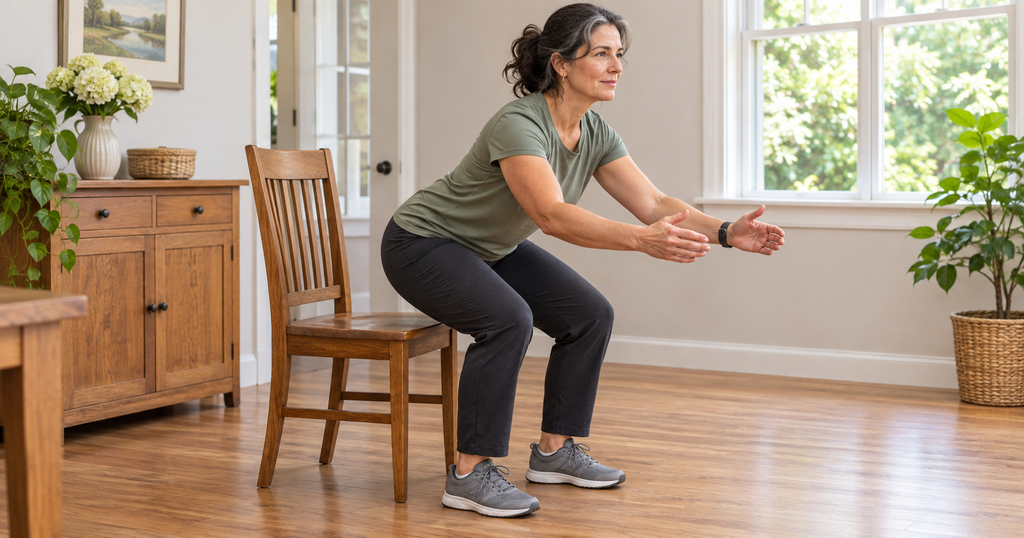
Think about the last time you got up from a deep sofa. Maybe you scooted forward, tucked your feet underneath you, and gave yourself a little push. In those few seconds, your thighs, hips, and sense of balance worked together to get you on your feet. That everyday movement is the sit-to-stand exercise, and a sturdy dining chair is all you need to practice it.
For women over 40, it’s a practical way to work on lower-body strength for the things we want to keep doing comfortably, from getting out of a restaurant booth to standing up after tying a grandchild’s shoes. Here’s how to practice a chair rise, why lowering yourself matters, and where balance training fits as you age.
Stronger Legs After 40 Start With How You Get Out of a Chair
Have you ever settled into someone’s wonderfully comfortable sofa and then, when it was time to leave, thought, Well, now I have to get out of this thing? You slide toward the edge, bring your feet closer, and lean forward. Chances are you’ve made those adjustments without giving them a second thought.
Pay attention the next time, though, because there’s a useful exercise tucked inside that ordinary moment. When you rise from a chair, the muscles in the front of your thighs help straighten your knees, the muscles around your hips help bring you upright, and you steady yourself over your feet before you walk away. Practicing that sequence is a simple way to give your legs and hips some focused attention after 40.
What your legs and hips do when you stand
Standing up begins while you’re still sitting. With your weight resting on the seat, try to picture where it needs to go next. Your feet are on the floor a little way in front of you. Leaning forward at the hips brings your upper body closer to that base of support. From there, your legs can press against the floor and lift you from the seat. This is why the small adjustment you make before standing can matter as much as the push itself.
Your thighs and hips have another job when you sit back down. They help control the descent as your knees and hips bend. It’s easy to overlook this half of the exercise, especially when the chair is right behind you and gravity is quite willing to finish the job. Try paying attention to those last few inches. Lowering yourself gently gives you a chance to practice control through a part of the movement you might usually rush.
Why give this movement attention in midlife?
Much of the conversation about exercise after 40 revolves around weight. Getting up from a chair offers a different question worth asking: What would I like my body to keep doing comfortably? Maybe it’s getting out of a beach chair, climbing the steps to a friend’s front door, or rising from the kitchen table with your hands full. Those are meaningful reasons to make room for strength work.
Researchers have studied this movement in women in midlife. In a UK study of 2,319 women, researchers included timed chair rises, grip strength, and a one-leg standing test when assessing physical function around the menopausal transition. That detail is worth a closer look. The researchers assessed rising from a chair and balancing on one leg separately because the tasks capture different aspects of how we move. The study also gives us a reason to discuss physical function during midlife without assuming menopause explains every change a woman notices.
For adults, the CDC recommends muscle-strengthening activities on at least two days each week, covering all major muscle groups, including the legs and hips. Chair rises can be one part of that larger routine. And if you’re starting from very little structured exercise, practicing a movement you already know gives you a straightforward place to begin.
How to do the sit-to-stand exercise
Start with a firm dining chair on a level, nonslip surface. Choose one without wheels and with a seat height that allows both feet to rest flat. If you usually use armrests to get up, choose a stable chair with arms so you have the support you need. Save the deep sofa for relaxing.
- Find your starting position. Move toward the front portion of the seat. Keep enough of your thighs supported to feel secure. Place your feet about hip-width apart, underneath or slightly behind your knees, with your heels down.
- Lean forward from the hips. Keep your gaze ahead and tip your upper body forward slightly. The familiar cue nose over toes can help you picture the direction of travel. There’s no need to bend so far that you feel unsteady.
- Press through your feet and rise. Straighten your knees and hips until you’re upright. Use your hands on the armrests if needed. Once you’re standing, pause long enough to feel settled over both feet.
- Sit down with the same attention. With the chair directly behind you and the backs of your legs touching it, bend at your hips and knees. Reach for the armrests if helpful and ease yourself onto the seat. Reset your feet before the next repetition.
Try this: At the end of breakfast, before picking up your plate, give one chair rise your full attention. Notice where your feet feel most stable and whether you can sit back down gently. If the movement feels comfortable, build toward a few slow repetitions. The NHS suggests five as an initial exercise target. You can start with fewer.
Give balance its own moment, too
Rising from the table and stepping sideways to let someone pass are two different challenges. During a chair rise, both feet stay planted. To step sideways, you have to transfer enough weight onto one leg to free the other foot. It makes sense to give both movements a place in your routine.
One option is a supported side step. Stand facing a clear stretch of kitchen counter so a stable surface is within reach. With your knees soft, slowly step to one side, then bring your other foot toward it. After a few comfortable steps, return in the opposite direction. Give yourself time to feel the weight shift before moving the second foot. If you already feel unsteady during normal walking or have been falling, ask a healthcare professional or physical therapist to help you choose a suitable starting point.
What does this mean for preventing falls later in life? Research in older adults supports programs that combine balance challenges with lower-body strengthening, and CDC guidelines specifically include balance activities for adults 65 and older. Can doing chair rises alone in your 40s prevent a fall decades later? I cannot confirm this. What you can practice today is concrete: rising from a seat, controlling the return, and finding your balance before you take a step.
Notice what changes for you
Choose an everyday detail you care about. Perhaps you’d like to lower yourself into your favorite chair more smoothly or feel settled before you start walking. Practice occasionally with the same chair so you can pay attention to that detail. You don’t need a stopwatch, and there’s no prize for getting up before your coffee is ready.
Also notice what makes the movement difficult. Feeling your thighs work is a different experience from getting lightheaded every time you stand. If you repeatedly feel dizzy, develop pain that interferes with standing, or notice a new change in your balance, discuss it with a healthcare professional. That distinction matters because balance can be affected by several factors, including vision, inner-ear problems, and medications. Doing more repetitions won’t tell you which one is involved.
The Bottom Line
For women over 40, the appeal of the sit-to-stand exercise is how closely it matches real life. A few controlled chair rises give your thighs and hips something useful to do. The return to the seat deserves equal attention, especially if you tend to drop into the chair those last few inches. Alongside other strength work and balance activities, it’s a practical habit you can carry into the years ahead.
This week, pick one chair and one familiar cue, perhaps finishing breakfast or closing your laptop for the day. Keep your hands free, place your feet comfortably, and take your time standing up and sitting back down. Which part takes more attention for you: getting up, finding your balance, or easing back into the seat?
Reviewed by Coach Tammy
Coach Tammy Bar is a Certified Life Coach, Health Coach, Type 2 Diabetes Educator, and Humanistic Psychology Counselor with over 25 years of experience in health promotion through education.
She coaches women to improve their energy, metabolic health, and sustain healthy lifestyle habits. She helps women navigate midlife transitions, including blood sugar balance, hormone health, weight management, and lifestyle strategies that promote long-term vitality. Her approach combines science-based nutrition, behavioral psychology, and practical daily routines designed for real life.
Through TBHealthy, Coach Tammy educates women simplify health decisions and build habits that support energy, clarity, and resilience during hormonal changes such as perimenopause and menopause.
Medical Disclaimer: This article is for educational purposes only and does not replace personalized medical advice. Always consult your healthcare provider regarding medical conditions or treatment decisions.
Frequently Asked Questions
1. Which muscles does the sit-to-stand exercise work?
The muscles at the front of the thighs help straighten the knees, while the muscles around the hips, including the gluteal muscles, help bring the hips upright. These muscle groups also help control your movement as you lower yourself back onto the chair.
2. Where should my feet go when I get up from a chair?
Start with both feet flat, about hip-width apart and under or slightly behind your knees. From there, a small forward lean helps move your weight onto your feet. Choose a chair height that lets your heels stay down comfortably.
3. Is it okay to use my hands to stand up?
Yes. Use stable armrests if they help you stand and sit with control. Some exercise instructions suggest using the legs alone when comfortable, while falls-prevention guidance explicitly allows hand support. If you’ve recently started needing your hands for a movement that used to be easy, mention the change to your healthcare professional.
4. How many chair rises should I start with?
The NHS suggests aiming for five slow repetitions. If that sounds like a lot, begin with a smaller number you can perform comfortably. Pay attention to the final descent. Being able to sit down gently is a useful cue when deciding whether to do another repetition.
5. Do chair rises count as strength training after 40?
They can contribute to the lower-body part of your routine when the movement challenges your muscles. The CDC recommends working all major muscle groups at least two days a week. Chair rises cover part of that goal, so include other activities for your upper body and the rest of your major muscle groups.
6. Can the sit-to-stand exercise help prevent falls?
Chair rises are one movement used in some successful fall-prevention programs for older adults. Those programs also included activities that challenged balance during standing and stepping. Their results tell us about the combined program. They leave open how much chair rises contribute on their own, particularly for women beginning in midlife.
7. What if I feel dizzy when I stand up?
Pause and sit back down safely if you can. If the dizziness keeps happening, talk with a healthcare professional before using repeated chair rises as an exercise. Describe when it starts, how long it lasts, and whether you’ve fallen. Those details can help your clinician decide what to check, including blood pressure changes when you stand or possible medication effects.
Medical note: This article provides general health education. A healthcare professional or physical therapist can tailor movement advice to your needs if you have persistent pain, dizziness, or a history of falls.